Why Most Workout Tracking Fails (And What Serious Lifters Actually Need)
Why Most Workout Tracking Fails
And What Serious Lifters Actually Need
Most workout tracking apps start with good intentions.
You log sets, reps, and weight. Charts appear. Motivation spikes.
Then, a few weeks later, something quietly breaks.
Progress stalls.
The data feels meaningless.
And you realize the uncomfortable truth:
You’re tracking workouts — but you don’t actually know if you’re progressing.
This isn’t a motivation problem.
It’s a data problem.
1. Most Trackers Log Movements, Not Training Stress
Muscle growth doesn’t come from weight alone.
It comes from effective mechanical tension and fatigue.
Yet most apps only ask:
- Weight
- Reps
- Sets
What they ignore is what actually matters:
- How close was the set to failure?
- How many reps were left in reserve (RIR)?
- Was this harder or easier than last week?
Without that context, you’re not tracking training —
you’re just recording exercises.
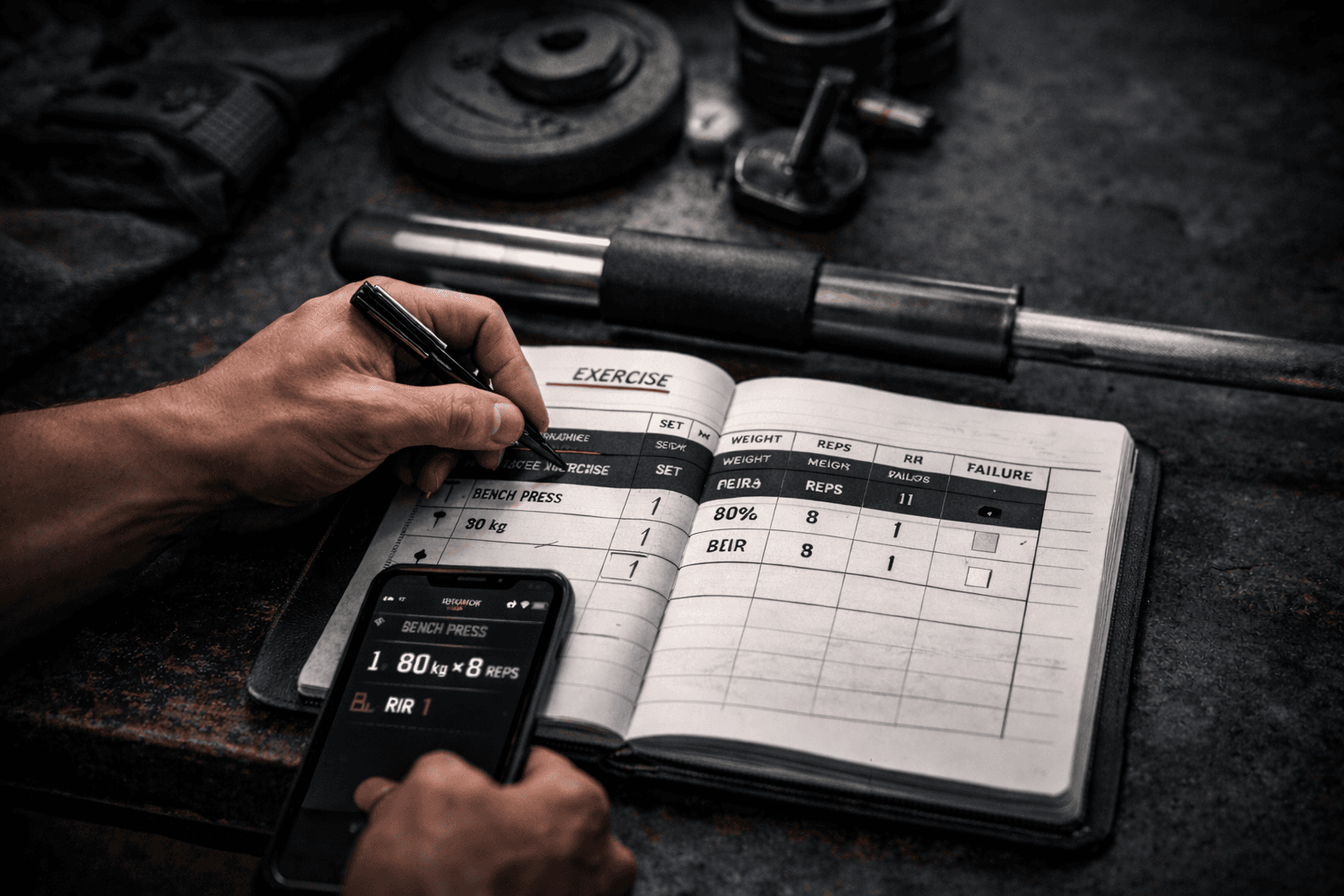
2. No RIR, No Failure = No Real Progression
“3 × 10 @ 80 kg bench press”
On its own, this tells you almost nothing.
- 3 × 10 @ RIR 4 → barely stimulative
- 3 × 10 @ RIR 1 → hypertrophy-focused
- 3 × 10 to failure → completely different fatigue cost
Most trackers store all of these as the same data point.
Weeks later, when you look back, you have numbers —
but no information you can actually use to make decisions.
3. If Your App Doesn’t Remember for You, It Slows You Down
Serious lifters think like this:
“What did I do last time on this lift?”
If your app doesn’t automatically surface:
- Last used weight
- Last rep count
- Last RIR
you’re forced to think, search, and guess —
right when you should be focused on execution.
That tiny bit of friction adds up.
And over time, it kills consistent progressive overload.
A good system doesn’t make you think.
It reminds you.
4. Rigid Programs Create Fake Consistency
Real training isn’t static.
- Splits evolve
- Exercises rotate
- Days get skipped
- Adjustments happen
But many apps force you into:
- Locked templates
- Inflexible programs
- “One correct way” structures
Serious lifters need:
- Full control over their split
- The ability to change things on the fly
- A system that adapts without breaking data integrity
If your tracker can’t adapt to your training,
you end up adapting your training to the tracker —
and that’s always a loss.
5. Numbers Without Interpretation Are Just Noise
Most apps collect data.
Very few answer the real question:
“What does this mean?”
- Is symmetry improving?
- Which muscle groups are lagging?
- Does your physique actually look better?
Serious lifters don’t train just to lift more weight.
They train to look better, proportionally and visibly.
If your system can’t evaluate outcomes,
it’s missing the entire point.
What Serious Lifters Actually Need
At minimum:
- Set-by-set logging (weight, reps, RIR, failure)
- Automatic recall of previous performance
- Flexible, user-defined programming
- Clear progression signals
- Interpretation, not just storage
A real system should be able to say:
- “You progressed here.”
- “You stalled here.”
- “This area needs more focus.”
Final Thought
Most workout trackers are built for casual users.
Serious lifters are not casual users.
If your training is:
- Intentional
- Measured
- Structured
Then your tracking system has to meet the same standard.
Otherwise, you’re just exercising —
not systematically improving.
And for serious lifters, that’s not enough. 💪